
Written by the Air Solutions LLC service team – NJ Master HVACR Licensed and NATE-certified. Last updated July 2026.
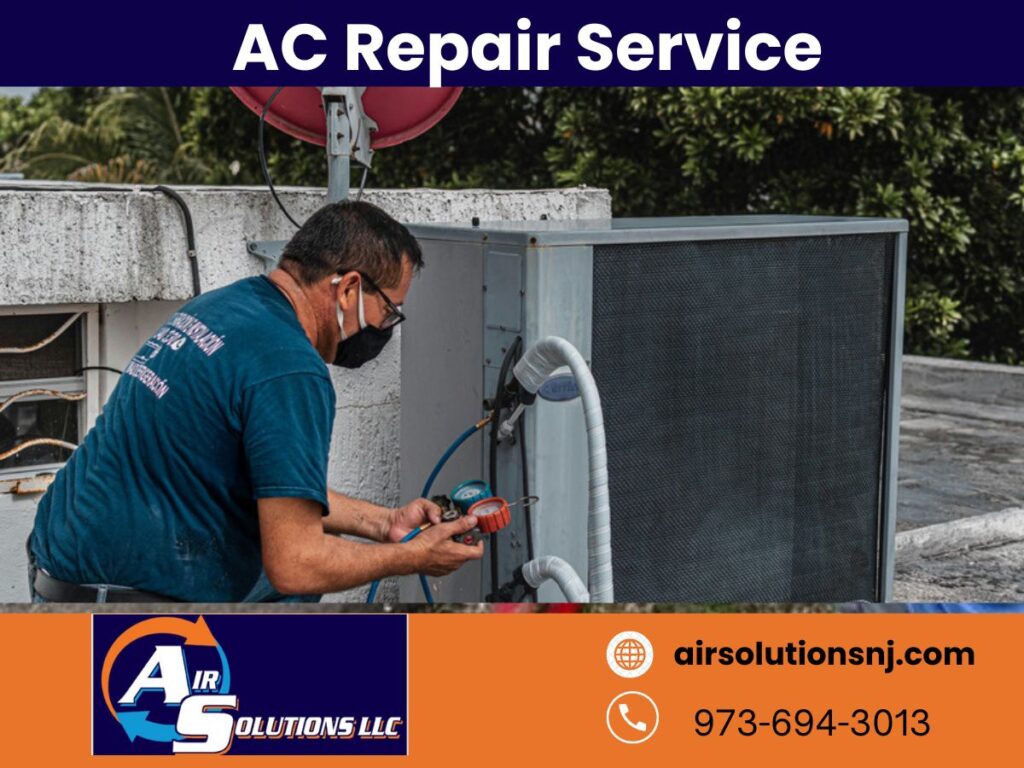
The compressor is the part of your air conditioner that actually moves heat out of your house. Everything else the coils, the blower, the thermostat supports what the compressor does. When it starts to go, your AC doesn’t just get less effective. It gets expensive, fast. A compressor repair might run a few hundred dollars. A full replacement can climb into the thousands. Catching the early signs is the difference between the two.
Here’s what to watch for, and what each sign actually means.
The air coming out isn’t cold
This is usually the first thing people notice, and it’s easy to write off as a fluke a hot day, a door left open, the thermostat set wrong. But if you’ve ruled those out and the vents are still blowing air that’s barely cooler than room temperature, the compressor isn’t circulating refrigerant the way it should. Refrigerant is what actually pulls heat out of your indoor air. No proper circulation, no cooling even if the system sounds like it’s running fine.
Strange noises from the outdoor unit
A working AC hums along quietly. A failing compressor doesn’t. Banging, clanking, or a high-pitched screech from the outdoor unit usually means something inside has come loose, or pressure inside the compressor has built up past where it should be. We had a call in Wayne where the homeowner described a rattling sound every time the system kicked on nothing dramatic, just consistent. That’s actually the pattern to worry about. A one-time noise might be debris in the unit. A noise that shows up every cycle is mechanical.
Short cycling
If your AC turns on, runs for a few minutes, shuts off, then starts again shortly after that’s short cycling, and it’s a sign the compressor can’t maintain the pressure it needs to complete a full cooling cycle. It overheats, shuts down as a safety measure, cools off, tries again. Repeat. Beyond being annoying, this puts real strain on the rest of the system and rarely fixes itself.
The system struggles to start
A healthy compressor kicks on smoothly. A failing one hesitates you might hear a hum, a click, then nothing, then another attempt a few seconds later. This is called hard starting, and it means the compressor is having trouble engaging. Left alone, this tends to get worse over weeks, not better.
The breaker keeps tripping
Occasional breaker trips can be a random overload. Breaker trips that keep happening, specifically when the AC kicks on, are a different story. A struggling compressor draws more current than it should, and the breaker is doing its job by cutting power before that turns into a fire risk. Don’t just keep resetting it that’s masking the symptom, not fixing anything.
Your electric bill is climbing and nothing else has changed
A compressor that’s losing efficiency has to run longer to hit the same temperature. Same thermostat setting, same house, same summer but a bill that’s noticeably higher than last year’s. That gap is worth paying attention to before it turns into a full breakdown.
Oily residue near the outdoor unit, or ice on the coils
Refrigerant leaks show up as an oily film around fittings or connections on the outdoor unit — refrigerant carries a small amount of oil with it, so a leak often leaves a visible trace. You might also see ice forming on the indoor coil, which happens when low refrigerant lets the coil get too cold. Either one points to a leak that, left unaddressed, can damage the compressor permanently.
Is it the compressor, or just the capacitor?
This is where a lot of homeowners get stuck, understandably. The capacitor is a small component that gives the compressor the jolt of power it needs to start. When a capacitor fails, the symptoms look almost identical to compressor failure hard starting, humming with no start, the outdoor unit not engaging at all.
The difference matters a lot for your wallet. A capacitor is a $150–$300 fix. A compressor is $800–$2,500 depending on the unit. You genuinely can’t tell them apart without testing this is one of those situations where guessing costs you either way, so it’s worth having someone check before you assume the worst.
What a repair or replacement actually costs
Compressor issues split into two buckets. Sometimes it’s a contained problem a bad start relay, a refrigerant leak that hasn’t caused lasting damage and a repair in the $400–$500 range gets the system running again. We’ve made calls in Wayne that landed exactly there: homeowner hears a noise, we diagnose it, it’s fixable without touching the compressor itself.
Full compressor replacement is a different scale typically $800 to $2,500 depending on the brand and unit size. If the compressor itself has failed outright, replacement is usually the only real option; compressors aren’t something you patch.
Repair or replace how to decide?
Here’s the threshold our technicians actually use in the field: if the repair cost is under 50% of what a full system replacement would run, and the unit is under 10 years old, repair makes sense. Past that line older system, repair pricing creeping toward half the cost of a new one you’re often better off putting that money toward a replacement instead of extending the life of a system that’s going to need attention again soon anyway. It’s not a law of physics. It’s just where the math stops favoring the patch job.
What to do right now if you suspect a failing compressor
Turn the system off. Running it while the compressor is struggling doesn’t buy you time it usually accelerates the damage. And if the breaker’s been tripping, stop resetting it and running the system again. That trip is the breaker doing exactly what it’s supposed to do.
From there, the only real next step is a diagnosis. Symptoms overlap enough — capacitor versus compressor, refrigerant leak versus airflow problem — that guessing at the cause usually means guessing at the fix too.
Can a bad compressor be repaired instead of replaced?
Sometimes. If the issue is a failed start component or a refrigerant leak caught early, a repair can resolve it. If the compressor’s internal mechanism has actually failed, repair generally isn’t an option — replacement is.
How much does it cost to replace an AC compressor?
Typically $800 to $2,500, depending on the size and brand of the unit. Smaller repairs unrelated to the compressor itself — a capacitor, a relay — usually run $150 to $500.
Is it safe to run my AC with a failing compressor?
Not for long. A struggling compressor draws more power than it should and can cause further internal damage the longer it runs. If you’re seeing tripped breakers or hard starting, it’s worth shutting the system off until it’s been looked at.
If you’re dealing with any of these signs in Wayne, our AC repair cost breakdown covers pricing in more detail, and our team can get a diagnosis scheduled quickly. If the problem turns out to be short cycling rather than a full compressor issue, our short cycling guide walks through that separately.